SportsKey Information
Athletic Field Maintenance Schedule: What to Block Off and When

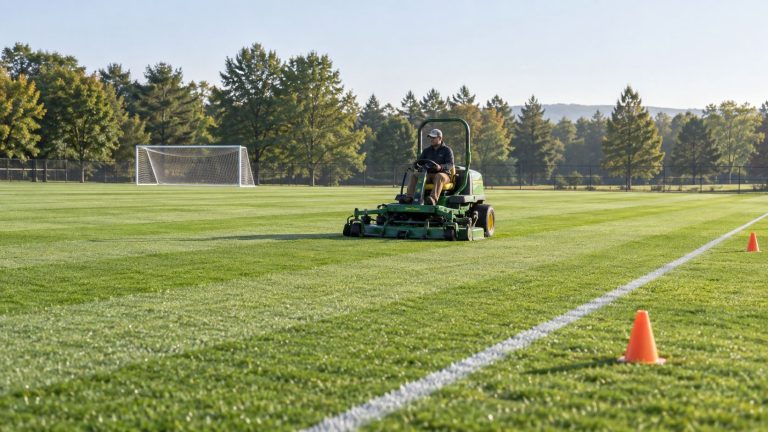
Your crew plans core aeration for Tuesday morning. On Monday, a club books a practice into the same slot online, because the aeration plan lives in a spreadsheet the booking system never sees. Either the crew goes home, or a team warms up on a field full of holes.
TL;DR: Athletic field maintenance only holds when the work sits on the booking calendar as blocked time. Natural grass needs mowing to the one-third rule, core aeration at least twice a year (spring and early fall for cool-season grass, spring and mid-to-late summer for warm-season grass), and planned rest. Synthetic turf needs grooming, infill checks, decompaction, seam inspections, and yearly Gmax testing. NC State Extension ties sustained good grass conditions to 200 hours of use or fewer per year. Put recurring maintenance blocks in your scheduling system so nobody books over them.
Contents
- Why does field maintenance belong on the booking calendar?
- What does a natural grass maintenance schedule look like by season?
- What does synthetic turf maintenance involve?
- How many hours a week does a field take before quality drops?
- How do you stop teams booking over maintenance windows?
- Sample annual athletic field maintenance calendar
- Key Takeaways
- Action Plan
- Frequently Asked Questions
Why does field maintenance belong on the booking calendar?
Maintenance belongs on the booking calendar because a field’s only closed when the booking system knows it’s closed. A groundskeeper’s notebook won’t stop a coach from reserving the slot online at 10 p.m.
The clashes repeat: aeration slips because a tournament took the weekend, or a team scrimmages across fresh seed.
NC State Extension’s field durability guidance makes the same argument from the agronomy side. It calls for open communication between field managers, schedulers, and field users, and for planning recovery periods at the start of the year. A shared calendar does both: the crew sees bookings, and renters see a closed slot.
What does a natural grass maintenance schedule look like by season?
A natural grass schedule follows the growth cycle, so heavy work lands when turf recovers quickest.
Mowing
The Sports Field Management Association (SFMA) sets a simple rule: never remove more than one-third of the grass blade in one cut. Frequency follows growth: cool-season grass grows fastest in spring, warm-season grass in summer. Mowing’s quick, so it fits into early mornings or gaps between sessions.
Core aeration
SFMA’s cultivation guidance calls core aeration the single most important tool for controlling compaction. It recommends coring every field at least twice a year, while the grass is actively growing.
- Cool-season fields (Kentucky bluegrass, perennial ryegrass, tall fescue): spring and early fall. Skip summer, when these grasses sit semi-dormant.
- Warm-season fields (bermudagrass): once in April or May, then again in mid-to-late summer. Heavily used fields, heavy soils, and fields due for overseeding need at least three to four corings a season.
Give aeration a full-day block, and book the recovery time your crew expects on top of the machine hours.
Overseeding and rest
Cool-season fields are usually overseeded in early fall, often paired with aeration. On warm-season fields, NC State lists perennial ryegrass overseeding as one way to keep a green surface over dormant bermudagrass. Seedlings establish better under lighter use, and a calendar holds what makes it stick.
NC State also recommends a reduced game schedule while grass is dormant, regular rest times for repairs, no play on saturated soil, rotating practice areas, and keeping practices on game fields to a minimum. Every one of those is a scheduling decision.
What does synthetic turf maintenance involve?
Synthetic turf maintenance covers grooming, infill management, decompaction, seam checks, cleaning, and impact testing. Turf carries more hours than grass, but it isn’t maintenance-free, and skipped work shows up as a harder surface.
- Grooming: Brushing stands fibers up and spreads infill. The manufacturer sets the interval, and the SFMA field guide lists failure to keep infill at the correct level among common warranty exclusions. Make the warranty’s interval a recurring block.
- Infill top-ups: Infill depletes with use and weather, so watch high-traffic zones like goalmouths. SFMA suggests checking depth with a gauge and considering an annual topdressing.
- Decompaction: Spiking equipment loosens packed infill. Block it separately from routine grooming.
- Seams and inlays: SFMA singles out seams, inlays, and painted areas during testing, and minor seam repair sits on the manager’s list.
Gmax testing measures surface hardness. Under ASTM F1936, readings from the F355 missile A device should stay below 200. The DC Department of General Services tests its turf fields every year and temporarily closes any field with a single reading above 200. Fixes run from an infill top-off (two to three days) to sectional replacement (two to three weeks). SFMA adds the Synthetic Turf Council’s tighter target of 164 or lower for the life of the field. You’ll want a test at least yearly, and more often on busy fields.
How many hours a week does a field take before quality drops?
A natural grass field stays in sustained good condition at about 200 hours of use a year or fewer, according to NC State Extension. Beyond 200, quality drops in steps.
| NC State annual use | Expected field condition | Weekly average over 52 weeks |
| 200 hours or less | Sustained good condition | About 3.8 hours or less |
| 400 to 600 hours | Good, with some thinning and localized wear | About 7.7 to 11.5 hours |
| 800 to 1,000 hours | Fair, with significant thinning and wear | About 15.4 to 19.2 hours |
| More than 1,000 hours | Significant turf loss, surface damage, higher injury risk | More than 19.2 hours |
The weekly column divides NC State’s annual figures by 52 (600 ÷ 52 = 11.5). NC State assumes a well-built bermudagrass field in near year-round use, practices included.
Seasonal operators, take note: squeeze 600 hours into a 20-week season and the field carries 30 hours a week (600 ÷ 20), with less recovery between sessions. NC State also warns one extremely wet game is enough to ruin a field.
There’s no equivalent published cap for synthetic turf. Maintenance time is the real limit, and SFMA puts labor for an average synthetic field at roughly 300 to 500 hours a year.
Your own booking records make the best benchmark, and NC State calls hours of use one of the easiest numbers to track.
How do you stop teams booking over maintenance windows?
You stop overlap by entering maintenance as recurring, non-bookable time in the same system teams use to reserve fields. Renters then see the slot as unavailable, and nobody’s stuck remembering the crew’s plan.
- Build recurring blocks first. Mowing and grooming windows go in before bookings open.
- Add seasonal work as dated blocks, each with a spare day for weather.
- Use buffers between bookings. A short gap leaves room for a debris sweep.
- Close part of a field when you only need part. If goalmouths need seed and rest, hold those zones and keep the rest bookable.
- Review usage hours monthly against the NC State ranges.
This is where athletic field scheduling software earns its keep. SportsKey lets you set recurring schedules, then layer practices, games, and league play on top without double booking. Booking buffers hold a gap between reservations, split facilities divide one field into separately bookable sections, and usage and occupancy reporting shows how hard each field’s working.
Two limits to plan around. Flexible schedules and booking buffers come with the Advanced plan and above, not the entry Pro plan. And SportsKey runs the calendar, not the agronomy, so Gmax readings and infill depth logs still belong in your maintenance records.
Soccer fields wear in predictable spots, per NC State: midfield, goalmouths, and sidelines. If you’re running several fields, see how soccer field scheduling software keeps a multi-field complex on one calendar.
A caution on growth, too. Lake Forest Academy swapped several Google Calendars for SportsKey and grew rental revenue 200% within three months, year over year (Lake Forest Academy case study). It’s a private school opening idle time to outside groups, so treat it as a ceiling, not a forecast. More rental hours also means more wear, so maintenance blocks have to grow with bookings.
Sample annual athletic field maintenance calendar
A starting template for a Northern Hemisphere facility. Shift dates for your climate and turf warranty.
| Season | Cool-season grass | Warm-season grass (bermudagrass) | Synthetic turf |
| Winter (Dec to Feb) | Minimal play on dormant or frozen turf, equipment servicing | Reduced game schedule on dormant turf, ryegrass-overseeded fields carry winter play | Snow removal per manufacturer guidance, grooming after thaw |
| Spring (Mar to May) | Core aeration once growth starts, mowing frequency rises | First core aeration in April or May | Deep groom and infill check before spring season |
| Summer (Jun to Aug) | No aeration, mow to the one-third rule, rest blocks between sessions | Peak growth and frequent mowing, second aeration mid-to-late summer | Grooming at the warranty interval, seam and inlay inspection, annual Gmax test |
| Fall (Sep to Nov) | Early fall aeration with overseeding, lighter-use holds while seed establishes | Last coring one month before fall overseeding, perennial ryegrass overseed | Infill top-up in high-wear zones, annual topdressing if needed |
Key Takeaways
- Maintenance kept outside the booking system gets booked over. Block it where teams reserve fields.
- Grass fields won’t hold up without two or more aeration windows a year.
- NC State links sustained good grass to about 200 hours of use a year, roughly 3.8 hours a week.
- Synthetic turf needs grooming, infill checks, and Gmax readings under 200.
Action Plan
- List every field you’re managing, with its surface type and last Gmax reading.
- Enter weekly and monthly maintenance as recurring blocks before bookings open.
- Add dated blocks for aeration, overseeding, and Gmax testing.
- Set a yearly hours target for each grass field.
- Keep practices on game fields to a minimum, and rotate practice areas.
Frequently Asked Questions
1. How often should athletic fields be aerated?
Grass athletic fields should be core aerated at least twice a year, according to SFMA. Busy warm-season fields need at least three to four corings a season.
2. When is the right time to aerate a cool-season field?
Spring and early fall are the right windows for cool-season fields. SFMA advises against summer aeration, since bluegrass, ryegrass, and tall fescue sit semi-dormant in summer heat.
3. How often should synthetic turf be groomed?
Synthetic turf should be groomed at the interval in the manufacturer’s warranty, and more often as use rises. Skipped grooming puts warranty coverage at risk.
4. What Gmax reading means a synthetic field needs work?
A reading of 200 or higher on the ASTM F355 missile A device means the field needs maintenance before play. The Synthetic Turf Council targets 164 or lower over the field’s life.
5. How many hours of use does a grass field handle per year?
A well-maintained grass field holds sustained good condition at about 200 hours a year or fewer, per NC State Extension. Past 1,000 hours, expect significant turf loss.
Plan the season on one calendar
If maintenance and bookings still live in separate places, book a SportsKey demo and see maintenance blocks, buffers, and usage reports on a live calendar.
Sources and plan details verified as of September 2026.
Case Studies
Real Success Stories
Explore how we’ve helped organizations like yours boost revenue, streamline operations, and elevate the customer experience.


